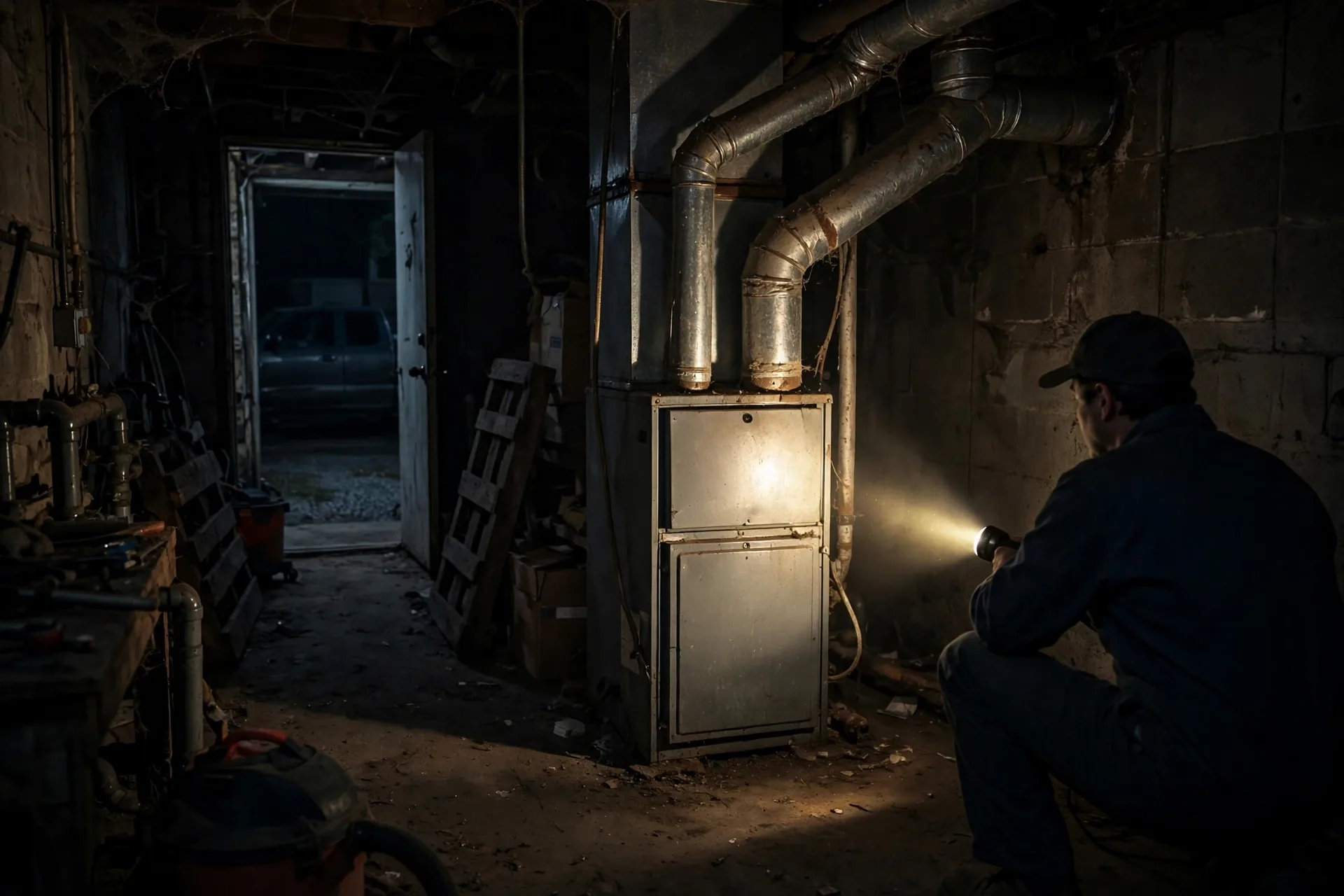
Silence is the symptom here: you lift the temperature setting, wait, and hear no inducer, no clicks, and no blower at all. Around Leesburg, a silent start often traces back to power, a thermostat fault, or a safety switch interrupting the sequence before ignition begins.
A furnace that stays silent has usually been stopped before ignition, not during it. The break can sit at the thermostat, in the power supply, at a safety switch, or on the control board that orders each step. Historic homes in old town Leesburg and newer houses in Ashburn fail at the same checkpoints, just for different reasons. Work through the safe checks below in order, and if the system still will not respond, call Loudoun Furnace Pros at (571) 561-3454.
The startup chain begins well before the furnace itself. The thermostat must notice the room is cold and send a low voltage call for heat. Dead batteries, a blank display, a broken wire inside the wall, or a schedule that quietly holds a lower setting can all erase that call while the furnace waits in perfect health. Power forms the second link. A tripped breaker, a furnace switch turned off by accident, or a cabinet panel left slightly loose after a filter change can open a door switch and leave the whole system dark. In a garage or basement that doubles as storage, that last link fails more often than most owners expect.
When power and the call both arrive, the control board takes over and runs a strict order of events. It starts the inducer, confirms draft through a pressure switch, energizes the igniter, opens the gas supply, and waits for the flame sensor to prove fire. A board with a failed relay or a scorched section can stop that order at any step, and many boards record a flashing fault code that names the step. Propane furnaces in western Loudoun follow this same sequence, with the added possibility of an empty or closed supply at the tank. A weak igniter may still glow in mild weather and fail only when longer, colder starts demand more from it.
Safety lockouts explain the most confusing version, where the furnace tried earlier and now ignores you completely. After repeated failed ignition attempts, the board locks the system down for a period rather than allowing endless tries. A flame sensor that could not prove fire, an igniter that weakened over several cold mornings, or a blocked vent termination after wind driven snow in a January cold snap can each end in that lockout. The silence then is the control protecting the house, and resetting it repeatedly without finding the cause only repeats the failure.
Work these checks in the order listed. Each one rules out a whole link in the startup chain, and none of them requires opening anything.
These checks end at switches and panels you can reach without tools. If you smell gas, leave the house and call the gas provider or 911 from outside. Never open the burner compartment, never touch gas lines, valves, or the heat exchanger yourself, and do not bypass any switch or keep resetting a breaker that trips again.
A furnace that will not start becomes an emergency when the house has no other heat during freezing weather. During a January cold snap, indoor temperatures in a Leesburg home can slide steadily through the night, and the risk shifts from discomfort to frozen pipes, especially in historic homes with plumbing in outside walls. If young children, older relatives, or medical equipment are in the house, or a carbon monoxide alarm sounds, treat the silence as urgent and call immediately.
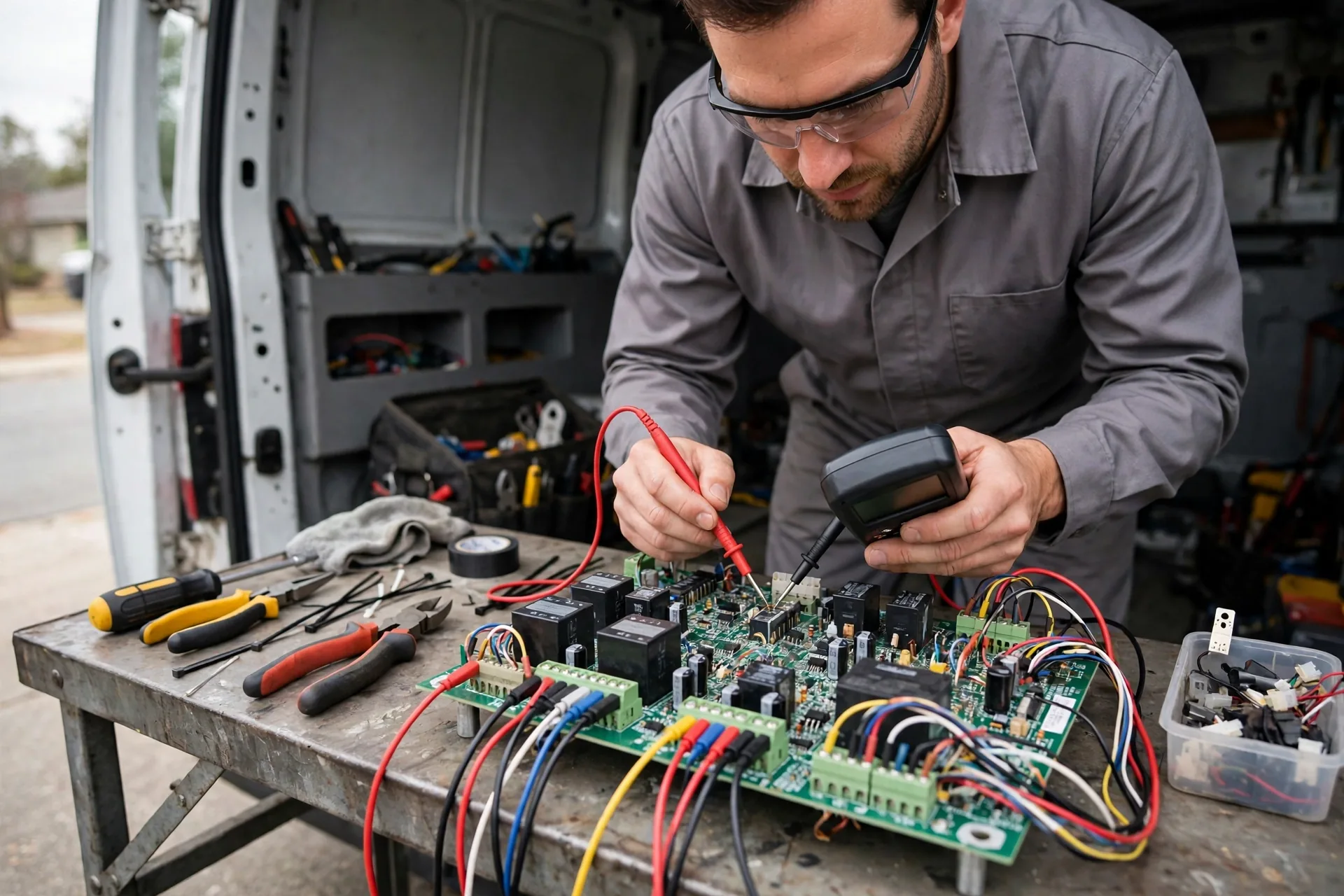
Diagnosis recreates the start under observation. The technician checks for the heat call at the board terminals, measures voltage through the switch, transformer, and board fuse, and reads any stored fault code before resetting anything. Each startup step is then prompted in order: inducer, pressure proof, igniter output, gas delivery, flame signal. The step that fails to answer identifies the fault family, whether that is a wall control problem, a power problem, or a component deep in the sequence. Voltage is checked at more than one point because a single reading can hide a switch, fuse, or connection that drops power only under load.
Many silent furnaces are resolved on our Thermostat Repair visits, where a failed control, damaged wiring, or lost power at the wall is corrected and the call for heat is proven at the furnace. Board, igniter, and sensor faults are repaired at the cabinet once the sequence points there. Every finding is explained in writing before work starts, including the code the board stored and what it means in plain language. When the wall control is at fault, its wiring and settings are verified with the furnace running, not simply replaced and assumed correct for this home.
A single successful start is not accepted as proof. The furnace is started several times in a row, allowed to run complete cycles, and shut down and restarted once more, because intermittent board and igniter faults often hide after one lucky ignition. You will see the failed part, hear a healthy sequence for comparison, and keep written notes on any borderline component that may need attention later in the season. If another component is nearing the end of its service life, that observation is noted separately from the repair you approved today.
Start with these answers when the thermostat gets no reply at all.
Describe what your furnace is doing and we will point you to the right next step.
Call (571) 561-3454Write down whether the thermostat display is lit, whether any sound at all follows a call for heat, and whether the breaker or furnace switch was found out of place. Note also when the furnace last ran normally and anything that changed since, like moved storage or a filter change. Those details narrow the first tests a technician runs on arrival.
Yes. Many high efficiency furnaces route condensate through a trap and, on some models, a float switch that stops the start when water backs up. The board treats that open switch like any other safety interruption and waits. Clearing the blockage and proving the drain flows restores the sequence. Because the switch sits inside the cabinet, that clearing is a technician task.
Wall controls powered by the furnace go dark when power is lost at the breaker, switch, transformer, or board fuse, so a blank display often points back toward the furnace power chain. Battery powered models behave differently and may stay lit while the furnace sits dead. Tell the technician which type you have, because that single detail redirects the opening tests.
Surprisingly common. The furnace switch looks like an ordinary light switch, often sits at shoulder height near the unit, and gets flipped by boxes, holiday decorations, or a shoulder brushing past in a tight utility room. In Loudoun basements and garages that double as storage, it is one of the first things worth checking before assuming a part has failed.
The technician reads the flashing code through the cabinet window before resetting the system, because a reset can clear the very evidence that names the failed step. The code is matched against the board chart, then confirmed with meter readings rather than trusted blindly. You get the code, its meaning, and the test result together in the written summary of the visit.
It runs and moves air, but the vents never warm. A different family of faults.
Starts that begin and then quit within minutes often share the same controls.
Blank displays, bad readings, and heat calls that never reach the furnace.
A silent furnace on a freezing Loudoun night is routed first, around the clock.
Describe exactly what happens, and what does not, when you call for heat. Silence has a pattern, and we will follow it.
Call (571) 561-3454