
Foothill Weather Works Furnaces Harder
Round Hill's position near the Blue Ridge means more wind exposure and slightly colder nights than Leesburg proper. Wind strips heat from homes faster, which means longer furnace runtimes and more wear per winter. Systems here age in dog years compared to sheltered locations.
Maintenance matters more at elevation. A fall tune-up before the windy season is the best defense.
Historic Round Hill Homes
The older homes near Round Hill's center have the same heating puzzles as any historic property: tight utility spaces, evolving ductwork, and insulation added in layers over decades. We approach these homes with diagnostic patience, not a sales pitch.
Newer Developments on the Slopes
Newer Round Hill construction on the hillsides often features multi-zone systems serving split levels. Zone controls add comfort but also add failure points: dampers, zone boards, and multiple thermostats that must agree. We diagnose the whole zone system, not just the furnace.
Elevation Changes Everything About Round Hill Winters
Round Hill sits higher than Leesburg, tucked against the Blue Ridge foothills, and elevation is a furnace's quiet enemy. Cold air is denser, wind exposure increases with altitude, and the temperature drops measurably compared to the valley floor. On a windy January night, a Round Hill home can feel the cold in ways that a sheltered Leesburg townhouse never will.
Wind is the dominant factor. The foothills catch westerly winds that sweep down from the Blue Ridge, and homes on exposed slopes or ridgetops lose heat far faster than the thermostat anticipates. The furnace responds with longer runtimes, which means more wear per winter than the same equipment would accumulate in a protected location. We think of Round Hill furnaces as aging in dog years.
The practical consequence: maintenance intervals matter more here. A system that could stretch to 18 months between services in a mild spot should be checked annually in Round Hill. The fall tune-up is not a luxury; it is how you find the weak igniter or tired capacitor before the windy season exposes it.
Appalachian Trail to Sleeter Lake: Round Hill Landmarks
Round Hill earned designation as an Appalachian Trail Community in 2019, and the A.T. passes just four miles from town. Bears Den, the historic stone mansion turned trail center, sits on the ridge above town offering some of the region's best sunrise views. Blackburn Trail Center, built in 1913, welcomes hikers in a mountain forest setting. The trail community identity shapes the town's character.
The Round Hill Historic District, listed on the National Register in 2009, preserves 204 contributing buildings mostly constructed between 1880 and 1920. Many began as boarding houses serving Washingtonians escaping the capital's summer heat via the railroad. The former Round Hill Railroad Depot from 1902 still stands. Ketoctin Baptist Church and several other historic churches anchor the district.
Sleeter Lake Park, dedicated in 2018 on the site of a former orchard, offers fishing and paddling on an 11-acre lake. The Hometown Festival every Memorial Day brings the whole town out for a parade. Williams Gap Vineyard and Good Spirit Farm represent the area's wine country credentials. Even Patsy Cline has a Round Hill connection: she attended Round Hill Elementary School.
Boarding Houses to New Suburbs: Round Hill Housing
Round Hill's oldest homes date to its era as a railroad resort town. The boarding houses of the 1880s and 1890s, built in Queen Anne style to host summer visitors from Washington, still line the historic streets. Many have been converted to private residences, but their bones remember the boarding-house era: multiple small rooms, later-added bathrooms, and heating systems threaded through spaces never designed for them.
The Gregg-Parks-Potts House dates to around 1775, and the Guilford Gregg Store to 1851. Heating buildings this old requires working within serious constraints: no wall cavities for ducts in the stone sections, plaster that cannot be disturbed casually, and a preservation ethic that rules out the easy answers.

Ringing the historic core, fast-growing suburbs have brought thousands of new residents to the developments outside town. These are modern homes with modern furnaces, often zoned for their split levels and multi-story layouts. The contrast could not be sharper: 1890s boarding house on one street, 2020s colonial on the next. Our technicians read each house on its own terms.
Wind, Zones, and Other Round Hill Furnace Stressors
Wind-driven heat loss is Round Hill's signature heating challenge. On gusty nights, the effective heating load can spike well beyond the design calculation, and the furnace runs continuously trying to keep up. This is normal for the conditions, but it accelerates wear and exposes marginal components. If your furnace runs nonstop during wind events but cycles normally otherwise, the system is probably fine; it is the weather that is extreme.
Zoned systems in the hillside developments add complexity. Multiple thermostats, zone dampers, and a zone control board must all agree, and when they do not, symptoms get strange: one floor overheats while another stays cold, or the system short-cycles as dampers open and close. Diagnosing these requires testing the controls systematically, not just staring at the furnace.
Older homes contribute draft issues. Boarding-house-era construction was not built to modern air-sealing standards, and a century of settling has opened gaps. The furnace can be perfectly healthy and still struggle against a house that leaks heat like a sieve. Sometimes the right recommendation is weatherization, not equipment.
Fall Checklist for Round Hill's Hillside Homes
Schedule the fall tune-up early: September is ideal for Round Hill, before the windy season. The visit should include the full heating sequence test plus extra attention to the heat exchanger, which endures more thermal stress here, and the blower motor, which logs more hours.
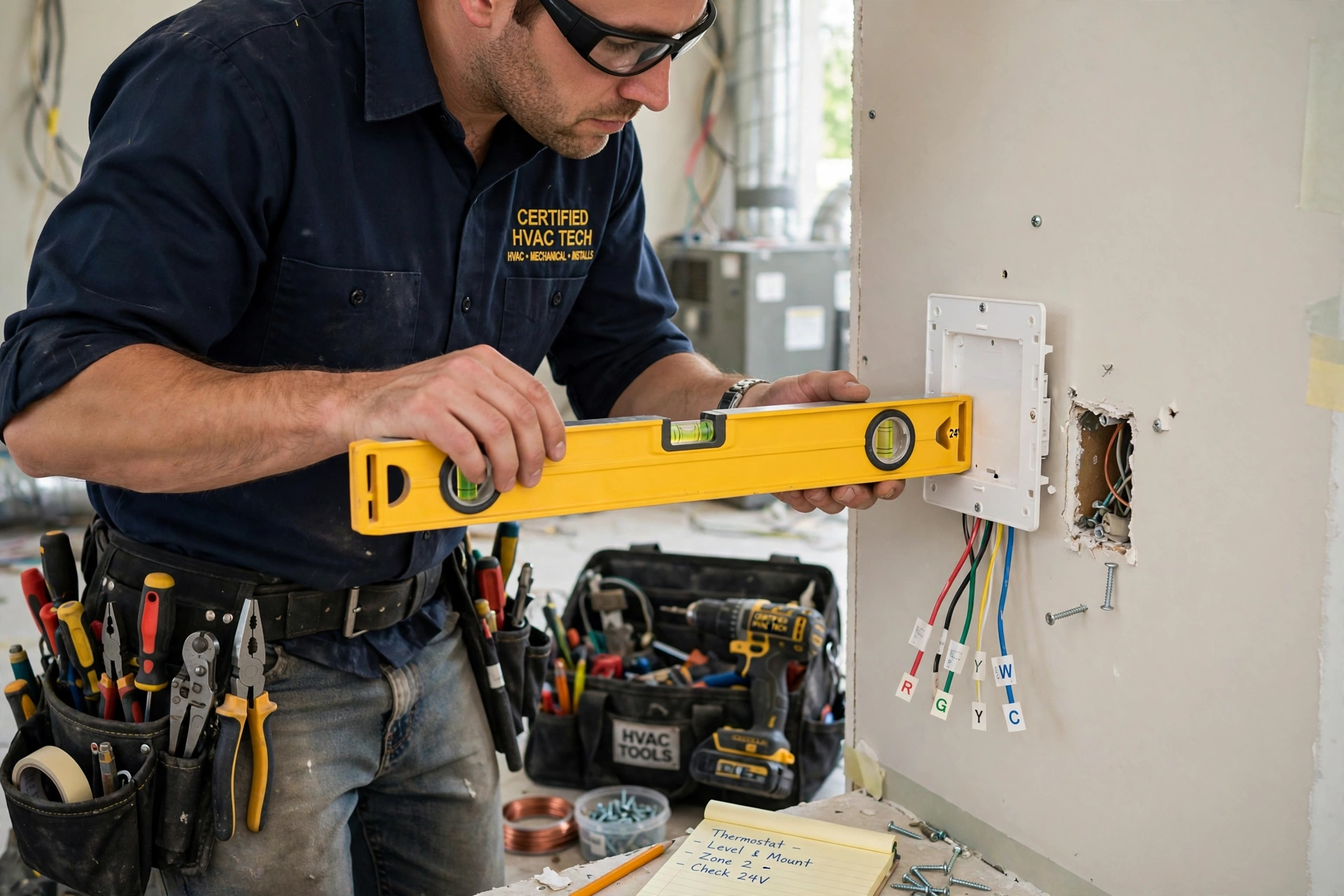
For zoned homes, ask the technician to test each zone independently: damper operation, thermostat communication, and temperature delivery per zone. Catching a stuck damper in October beats discovering it in January when one floor is freezing.
Walk the house for drafts before winter. Pay special attention to north and west-facing walls, which take the brunt of the foothill wind. Check attic insulation depth, seal obvious gaps around pipes and wires, and make sure the crawl space vents are in their winter position. Call (571) 561-3454 to get on the fall schedule.
What Our Technicians See in Round Hill Homes
Round Hill's elevation creates a diagnostic category we rarely see elsewhere: wind-driven heating complaints. Homeowners describe furnaces that work perfectly on calm days but cannot keep up when the wind picks up. The system is not broken; it is correctly sized for normal conditions and overwhelmed by abnormal ones. Explaining this honestly, rather than selling unnecessary equipment, is part of the job.
The historic district's boarding-house-era homes present fascinating heating archaeology. We have found ductwork from three different decades in a single house, each layer reflecting the heating technology of its time. Untangling these systems requires patience and a willingness to map before acting. The reward is a heating system that finally works as a coherent whole rather than a collection of compromises.
In the newer hillside developments, the zoned-system calls dominate. The pattern is consistent: beautiful homes with sophisticated zone controls that were never properly commissioned. Dampers installed backwards, thermostats wired to the wrong zones, bypass ducts missing or undersized. Fixing these is deeply satisfying work because the improvement is immediate and dramatic.
Round Hill reminds us that every house has a story, and the heating system is one chapter. Reading the whole story before writing the next one is what separates a technician from a parts-changer.
Getting to Your Round Hill Home: Our Service Area Detail
We cover Round Hill's historic district and Main Street, the residential neighborhoods surrounding the town core, the hillside developments on the slopes toward the Blue Ridge, and the rural properties along the roads toward Bluemont, Snickers Gap, and the Appalachian Trail corridor.
The areas near Bears Den, along Blue Ridge Mountain Road, and the communities toward Sleeter Lake are included. For hillside properties, mention the driveway grade and winter access when you call during cold weather; steep driveways can be challenging in ice and snow.
Round Hill sits at the western edge of our regular service area, and we route it with Purcellville and Hamilton for efficiency. Emergency calls get immediate dispatch regardless of routing. Call (571) 561-3454 and describe your situation; we will give you an honest arrival estimate.